Early 19th Century Georgian Pine Fall-Front Writing Bureau Desk, c.1820–1840


Early 19th Century Georgian Pine Fall-Front Writing Bureau Desk, c.1820–1840
Early 19th Century Georgian Pine Fall-Front Writing Bureau Desk, c.1820–1840
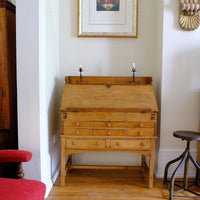
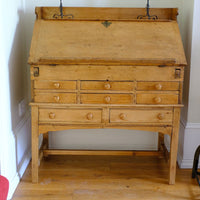
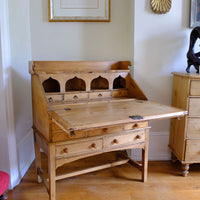
An unusually constructed Early 19th Century Georgian Pine Fall-Front Writing Bureau Desk, c.1820–1840, combining a substantial fitted writing cabinet with a separate stretchered base. Its warm time-worn pine, architectural pigeonholes, concealed storage and remarkably complete writing arrangement give this bureau a character quite apart from more conventional examples.
Key Features
- Early 19th-century Georgian pine fall-front writing bureau, c.1820–1840
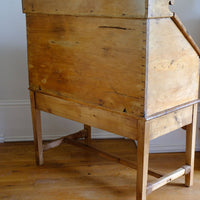
- Two-part construction with separate fitted bureau cabinet and stretchered stand
- Eight external drawers with a further four internal drawers
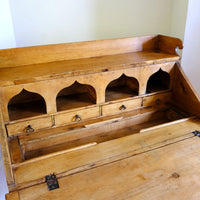
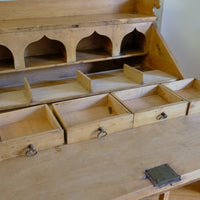
- Four distinctive pointed ogee-arched pigeonholes for letters and correspondence
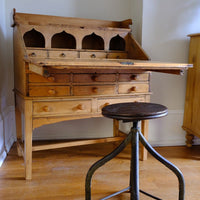
- Breadboard-ended fall forming a generous horizontal writing surface
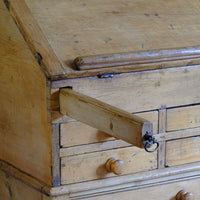
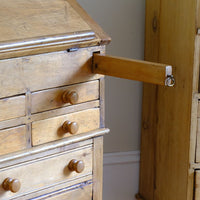
- Pair of stopped retractable wooden lopers supporting the opened fall
- Raised moulded book, newspaper or document rest incorporated into the fall
- Sliding correspondence compartment with additional concealed storage beneath
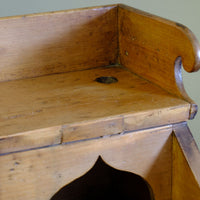
- Galleried top with shaped scroll terminals and provision for an ink pot
- Exceptional naturally aged pine surface with generations of wear and patina
Description
This early 19th-century Georgian pine writing bureau is an unusually thoughtful example of vernacular cabinetmaking, combining considerable functionality with restrained architectural detail.
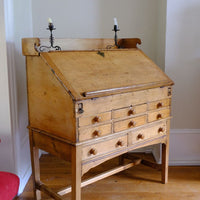
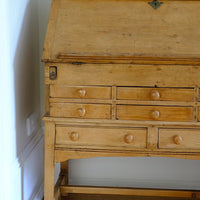
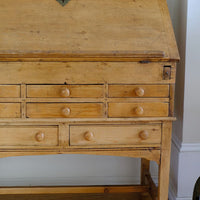
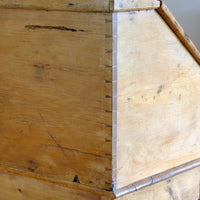
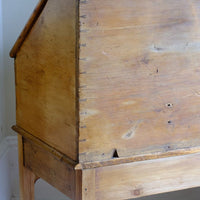
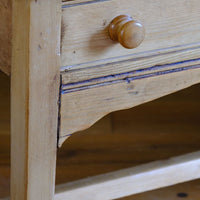
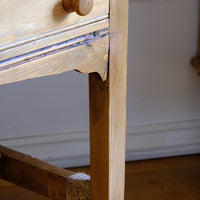
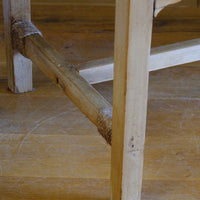
Constructed in two principal sections, the substantial upper bureau cabinet sits upon a separate pine stand. The upper carcase is joined with large hand-cut dovetails, while the lower section incorporates two cock-beaded drawers above a subtly scalloped apron, square supports and an H-form stretchered base. Historic rope binding to the stretcher joints forms part of the bureau's long working history.
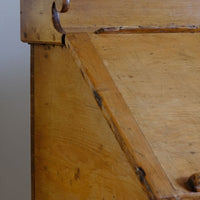
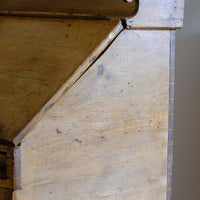
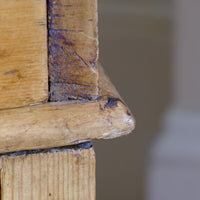
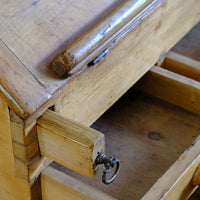
The closed fall presents a broad sloping surface framed by breadboard ends and carrying a raised moulded edge. This terminates before the two retractable wooden fall supports, allowing the supports to be drawn forward without fouling the moulding. The arrangement allows the slope to function as a rest for a book, newspaper or documents when closed, while opening to create a generous horizontal writing desk.
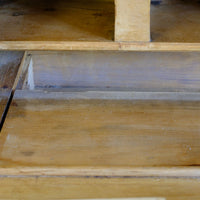
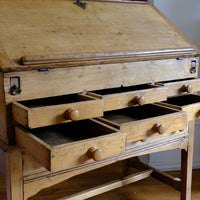
Behind the fall is a particularly engaging fitted interior. Four pointed ogee-arched pigeonholes provide storage for letters and papers, with four small drawers beneath retaining brass ring pulls. Further sliding elements create a long correspondence compartment, while removal of the internal drawer arrangement reveals an additional concealed lower cavity suitable for valuables and private papers.
Across the exterior are six smaller drawers within the upper cabinet and two larger drawers to the stand, giving eight external drawers in addition to the four internal drawers. The smaller internal drawers employ straightforward nailed construction, contrasting with the substantial hand-dovetailed outer carcase and more refined cock-beaded lower drawers — a revealing hierarchy of early cabinetmaking techniques.
Above the fitted interior is a shallow galleried shelf terminating in distinctive shaped scroll ends. An aperture within the gallery appears intended to accommodate an ink pot, now absent.
Perhaps most compelling is the bureau's surface. Scratches across the writing fall, softened mouldings, darker areas around working components, small knocks, old marks and variations in the honey-coloured pine record generations of handling and use. Rather than disguising its age, the surviving surface allows nearly two centuries of working life to remain visible.
To explore the bureau beyond its physical form, read the accompanying Journal article, where we look more closely at its hand-cut construction, architectural interior, hidden compartments and the working rituals of an early 19th-century writing desk.
Explore our wider collection of antique desks and writing furniture, including distinctive examples chosen for their construction, surface and individual character.
Dimensions (approx.)
Height: 110 cm
Width: 94 cm
Depth: 52.5 cm
Protrusion of desk area when open: 40 cm
Height of the fall front writing area is 74cm
Materials
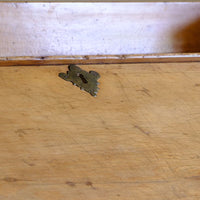
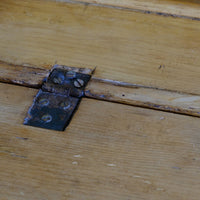
Pine construction throughout with large hand-cut dovetail joints to the upper cabinet carcase, nailed internal drawers, breadboard-ended writing fall, wooden drawer knobs, cock-beaded lower drawer fronts and moulded timber detailing. Brass ring pulls to the internal drawers, metal escutcheon and lock, and historic metal fittings to the writing mechanism. Stretchered pine base with historic rope-bound joints.
Condition
Good antique condition consistent with approximately two centuries of use. The bureau retains extensive surface wear, scratches, knocks, softened edges, old marks and colour variation throughout, contributing substantially to its character and naturally developed patina.
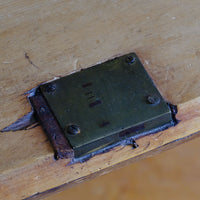
Historic wear. small minor losses and repairs are visible, including old rope binding around stretcher joints. The fall, mouldings and writing surfaces show particularly attractive evidence of prolonged use. Lock present behind the escutcheon; no key. Ink pot absent. Wear and minor movement are consistent with age and vernacular construction.
General Note:
Our pieces have lived a life before coming to Campbell Vintage. As genuine antique and vintage items, they will naturally display signs of age, use and character, including minor marks, losses, wear, fading and patina acquired over time.
Where there is visible historic evidence of woodworm, the piece is carefully inspected and treated as a precaution, regardless of whether there are any signs of current activity.
These characteristics form part of the piece’s authenticity and history. Please refer to the detailed condition report and photographs for a full assessment.
Origin / Period
Origin: England
Period: Early 19th Century / Late Georgian
Date: c.1820–1840
Styling Suggestions
At 94 cm wide, this Georgian pine writing bureau provides substantial working and storage capacity without the scale of a conventional bureau bookcase or large writing desk. It works naturally in a study, living room, hallway or bedroom, where the warm aged pine can sit comfortably alongside both period furniture and more contemporary interiors.
Closed, its sloping fall and scroll-ended gallery give the bureau a strong architectural silhouette. Open, the fitted interior and generous writing surface transform it into a practical home writing desk.
FAQ
Q: Does the fall form the writing surface?
Yes. Two retractable wooden lopers pull forward to support the fall horizontally, creating a substantial writing surface.
Q: How much storage does the bureau have?
There are eight external drawers and four internal drawers, together with four pigeonholes, a sliding correspondence area and additional concealed storage.
Q: Is the surface restored?
The bureau retains extensive age-related wear and an appealing time-developed surface. Historic marks, repairs and variations have deliberately not been disguised.
Q: Does it retain its key and ink pot?
No. The lock and escutcheon remain, but the key and original ink pot are absent.
Why This Object Stands Apart
The distinction lies as much in how this bureau works as in how it looks. Hand-dovetailed carcase construction, breadboard-ended fall, stopped retractable supports, architectural pigeonholes, twelve drawers, correspondence storage and a concealed cavity demonstrate a remarkably considered approach to writing, organisation and privacy.
Its surviving wear completes the story. This is not simply decorative patina but physical evidence of an object designed to be opened, written upon, organised and used repeatedly over generations.
All your questions answered below...
- Fully insured delivery
- Returns accepted
- Authenticity assured
- UK-based seller, secure checkout
Delivery & Shipping Information
We’re dedicated to delivering every order with care, reliability, and your satisfaction at the heart of what we do.
Fully insured UK mainland delivery is calculated at checkout (typically £12–£45). Larger furniture items may be £60+ depending on item size, access, and delivery postcode.
Please note: the listed price is for the item only. Delivery costs are calculated separately at checkout.
UK Delivery (Mainland)
We are based in Southsea, Portsmouth (PO5) and deliver nationwide across the UK.
Delivery charges are calculated based on the item’s size, weight, and destination to ensure the most accurate and fair pricing.
Free local delivery may be available depending on your location — please get in touch to check availability.
Delivery Areas & Coverage
We deliver to most UK regions and aim to provide the most efficient and cost-effective delivery options available.
For delivery addresses north of Newcastle, or within Wales, Scotland, the Highlands, Ireland, and offshore islands, please contact us before purchasing so we can confirm delivery availability and provide an accurate quote.
International Shipping
We can arrange international shipping worldwide.
Please contact us for a tailored shipping quote.
Delivery Times & Method
Delivery typically takes 5–10 working days, depending on location and order timing.
We use trusted specialist furniture couriers experienced in transporting antiques, vintage furniture, and fragile items, ensuring safe handling throughout transit.
Standard delivery is one-man delivery to ground floor only.
Assistance may be required unless a two-man delivery service is arranged at an additional cost.
Need a Delivery Quote?
For an accurate delivery quote or to confirm any additional charges, please contact us via:
📞 +44 (0) 7973 154860
💬 WhatsApp (button available on any page)
✉️ Email us with your full delivery postcode
We can ship to most places. We have the ability to to send consignments Internationally and they are all professionally wrapped, packed and or crated for a safe and successful journey.
There is going to be additional costs and lead times depending on various factors.
The best advice is to get a quote before you decide to purchase any item/s.
Listed in every product description are the dimensions for each product.
This information is provided so you can check if the piece you wish to buy will fit in your home.
Please double check your dimensions. One, to make sure it will fit through any doorway in to your home. Secondly, to make sure it fits in the space you want to place in it in. If in doubt, ring for help!
Any questions please get in touch, here to help.
Our pieces have lived a life before coming to Campbell Vintage. As genuine antique and vintage items, they will naturally display signs of age, use and character, including minor marks, losses, wear, fading and patina acquired over time.
Wherever possible, we favour careful conservation over full restoration, preserving the original surfaces and natural character of each piece. Every item is individually inspected and prepared, with any notable restoration or repairs detailed in its product description.
Where there is visible historic evidence of woodworm, the piece is carefully inspected and treated as a precaution, regardless of whether there are any signs of current activity.
These characteristics form part of the piece’s authenticity and history. Please refer to the detailed condition report and photographs for a full assessment.
It now explains your philosophy very clearly: age is expected, preservation is intentional, each piece is individually assessed, and relevant work is disclosed.
If you would like to speak to someone before placing an order, check dimensions or have a general question, please call Mark on 07973 154860.
You can email mark (@) campbellvintage.co.uk
Alternatively you can use the Live Chat on our website
(bottom left hand corner), message us via WhatsApp or via our
Instagram account.
Office Address: 71 Campbell Road, Southsea, PO5 1RJ. By appointment only to this address. Need to be booked in advance.
Always here to help.
Our products come with a guarantee stating they are as described when purchased.
As all our products are either antiques or vintage and have a life before we got them, we do not offer traditional warranties due to the age, nature of the items and their history.
Please inspect the many images we provide online to be sure you want the item offered before purchasing.
The condition of each product is noted on all products in the main description. Please read this so you are clear on what you are buying.
If you have any questions however small beforehand and to give yourself peace of mind, please make contact. As we are very happy to discuss anything in greater detail.
One last thing! Please double check your dimensions. One, to make sure it will fit through any doorway in to your home. Secondly, to make sure it fits in the space you want to place in it in. If in doubt, ring for help!
Here to help.
We hope you will be happy with your purchase. If for any reason you are unhappy, you may return the item/items to us within 14 days. Please notify us within 14 days.
You will need to arrange for the safe return of any item or items purchased. Please ensure the goods are returned in the same condition as sent to you.
You will be responsible for all return cost.
Once we have received your return, we will refund you the cost of the item/items, less any initial delivery and packaging costs, within 14 days.
Last of all, if returning an item, please advise us when we are likely to expect the item. We can then book this in and make sure we are available to except the item.
If you have any questions please contact us before ordering.
Here to help.
All direct payment gateways adhere to the standards set by PCI-DSS as managed by the PCI Security Standards Council, which is a joint effort of brands like Visa, MasterCard, American Express, and Discover.
Trade sale. Sold as seen. No returns.